
Nutrition-focused practices have a unique operational challenge: the patient relationship often extends far beyond a single appointment. A dietitian or nutritionist may need to document detailed assessments, track progress over multiple visits, manage follow-up care, coordinate supplements or lab work, and collect recurring payments for programs or memberships. When those workflows are spread across several disconnected systems, even a growing practice can quickly become difficult to manage.
The right nutrition software can bring those pieces together.
For dietitians, nutritionists, functional medicine providers, wellness clinics, and other specialty practices, practice management software needs to do more than store clinical notes. It should support the way these practices actually operate, from patient intake and documentation to scheduling, payments, lab management, and ongoing care.
This guide explains what to look for in nutrition practice software and how to evaluate whether a platform is a good fit for your practice.
What Is Nutrition Software?
Nutrition software refers to software designed to help nutrition professionals manage clinical, administrative, and financial workflows.
Depending on the practice, this may include tools for:
- Patient scheduling and appointment management
- Electronic health records and clinical documentation
- Nutrition assessments and care plans
- Patient communication and portals
- Lab ordering and result management
- Supplement and product management
- Memberships and recurring payments
- Insurance billing and superbills
- Cash-pay programs and packages
- Telehealth workflows
- Reporting and financial management
Not every nutrition practice needs every feature. A solo dietitian seeing patients for one-on-one counseling may have very different requirements from a functional medicine clinic offering nutrition programs, laboratory testing, supplements, and memberships.
That distinction matters when choosing software.
Why Specialized Nutrition Practices Need More Than a Basic EHR
Nutrition counseling is often highly individualized. Two patients may have the same general health goal but completely different dietary histories, symptoms, laboratory findings, preferences, and follow-up plans.
The documentation needs to reflect that.
A general-purpose EHR may handle basic patient records and appointment notes, but nutrition-focused practices often need more flexibility in how information is documented and organized.
There is also an operational side that can get overlooked.
Many nutrition practices use a combination of:
- An EHR
- A scheduling platform
- Payment processing software
- A spreadsheet or separate system for memberships
- A supplement dispensary
- A patient messaging platform
- Lab portals
- Accounting software
Each tool may work well individually. The problem is managing the handoffs between them.
When a patient signs up for a multi-visit nutrition program, for example, the practice needs to know what they purchased, how often they should be seen, what payments have been collected, and what documentation is associated with each visit.
The more systems involved, the more opportunities there are for information to fall through the cracks.
Key Features to Look for in Nutrition Practice Software
There isn't one "best" platform for every dietitian or nutritionist. The better question is whether the software supports your clinical model and the way your practice generates revenue.
Here are the capabilities worth prioritizing.
1. Flexible Clinical Documentation
Nutrition care can involve considerably more information than a standard office visit.
Providers may document dietary history, lifestyle factors, symptoms, goals, interventions, follow-up recommendations, and changes over time. Practices that combine nutrition with functional or integrative care may also need to incorporate laboratory findings and other clinical information.
Look for software that allows providers to customize documentation rather than forcing every patient into the same rigid template.
Customizable chart and note templates can help practices create workflows for different appointment types, services, or specialties.
The goal isn't simply to document more. It's to make documentation easier to complete consistently.
2. Patient Intake and Digital Forms
Nutrition practices often collect substantial information before the first appointment.
A patient may need to provide:
- Medical and dietary history
- Current medications and supplements
- Health goals
- Lifestyle information
- Food preferences
- Relevant symptoms
- Consent forms
- Other practice-specific information
Digital intake and e-signature capabilities can reduce the amount of administrative work required before an appointment.
They also give providers information to review before the patient arrives, which can make the first visit more productive.
3. Lab Management and Results
For nutritionists and dietitians working within functional, integrative, or wellness practices, laboratory data can be an important part of the patient record.
Nutrition software should make it practical to keep laboratory information connected to the patient's chart and care workflow.
This becomes especially valuable for practices that order or review recurring laboratory testing and need to compare results over time.
Rather than requiring providers to jump between a patient chart and external lab portals, integrated lab workflows can keep more of the patient's information organized in one place.
4. Supplement and Product Management
Supplements are a common part of many nutrition and integrative medicine practices.
If your practice sells supplements or maintains an inventory of products, look for software that can help manage that operational side of the business.
Useful capabilities may include:
- Inventory management
- Supplement tracking
- Lot or device serial tracking where applicable
- Product management
- Payment collection for products
Not every practice needs a full retail system. But if supplements are an important revenue stream, managing products separately from the patient record can create unnecessary administrative work.
5. Memberships, Packages, and Recurring Billing
Nutrition care doesn't always fit a traditional fee-for-service model.
A practice might offer:
- Monthly nutrition memberships
- Six- or 12-week programs
- Multi-visit packages
- Ongoing wellness programs
- Cash-pay care plans
- Hybrid insurance and cash-pay services
That means billing software needs to support more than one-time transactions.
Recurring billing can make membership-based models easier to manage, while package billing can help practices organize prepaid services.
When evaluating nutrition software, ask whether the platform can support the actual financial model you use rather than forcing the practice into a standard per-visit billing structure.
Nutrition Software Should Support the Business Model, Too
A common mistake is evaluating software exclusively from the clinical side.
Clinical documentation is important, but the software also needs to support how the practice gets paid.
Consider a nutrition practice that offers a $600 three-month program. The patient receives an initial assessment, several follow-up appointments, messaging, and additional resources throughout the program.
If the practice manages appointments in one system, payments in another, and patient communications somewhere else, staff may spend significant time reconciling information.
A more integrated approach can give the practice a clearer view of:
Patient → Service → Appointment → Payment → Documentation
That connection becomes increasingly important as the practice grows.
Cash-Pay Nutrition Practices Have Different Software Needs
Many dietitians and nutrition-focused providers operate outside traditional insurance models.
Cash-pay practices may offer memberships, packages, wellness programs, consultations, or specialized services that don't fit neatly into standard insurance billing workflows.
For these practices, useful software may include:
- Membership billing
- Recurring payments
- Packages
- Card-on-file functionality
- Online payments
- Digital receipts
- Patient portals
- Custom documentation
- Financial reporting
This doesn't mean insurance capabilities are irrelevant.
Some practices use a hybrid model, accepting insurance for certain services while offering cash-pay programs for others. In that situation, flexibility becomes particularly important.
What About Meal Plan Tracking?
Meal planning is often one of the first capabilities providers think of when searching for nutrition software.
It's important to distinguish between nutrition-specific clinical software and broader practice management software.
Some platforms are designed primarily around food diaries, meal planning, calorie tracking, recipes, or patient adherence. Those tools can be useful when meal planning is the central service being delivered.
Other platforms focus more broadly on managing the entire practice.
For a dietitian who needs robust meal-planning functionality, a dedicated nutrition platform may make sense. For a functional medicine or integrative practice where nutrition counseling is one component of a broader clinical workflow, an EHR and practice management platform may be a better fit.
The right choice depends on whether you need a nutrition planning tool or a complete system for running a nutrition-focused healthcare practice.
How to Compare Nutrition Software
Before choosing a platform, map your current workflow from the first patient interaction through payment and follow-up.
For example:
New patient → Digital intake → Appointment → Clinical documentation → Lab review → Nutrition recommendations → Follow-up → Package or membership payment
Then identify where each step currently happens.
If the process requires four or five separate platforms, those handoffs should be part of your software evaluation.
Questions to Ask During a Software Demo
When evaluating nutrition practice software, ask:
- Can providers customize clinical documentation and chart templates?
- Can patients complete intake forms electronically?
- Does the platform include a patient portal?
- Can providers communicate with patients through the platform?
- How are laboratory results handled?
- Does the system support supplements or inventory?
- Can the practice offer memberships or packages?
- Does it support recurring billing?
- Can the platform support both cash-pay and insurance workflows?
- What payment and billing tools are built in?
- Can providers manage different appointment types?
- What reporting is available for practice finances and operations?
- How does the platform handle patient data and security?
- Can existing patient data be migrated into the system?
- What does implementation and training look like?
A demo should answer more than "Does this feature exist?"
Ask the vendor to show you how the feature works within an actual patient workflow.
Best Software for Nutrition & Dietitian Practices: What to Prioritize
The best nutrition software depends on the type and size of your practice.
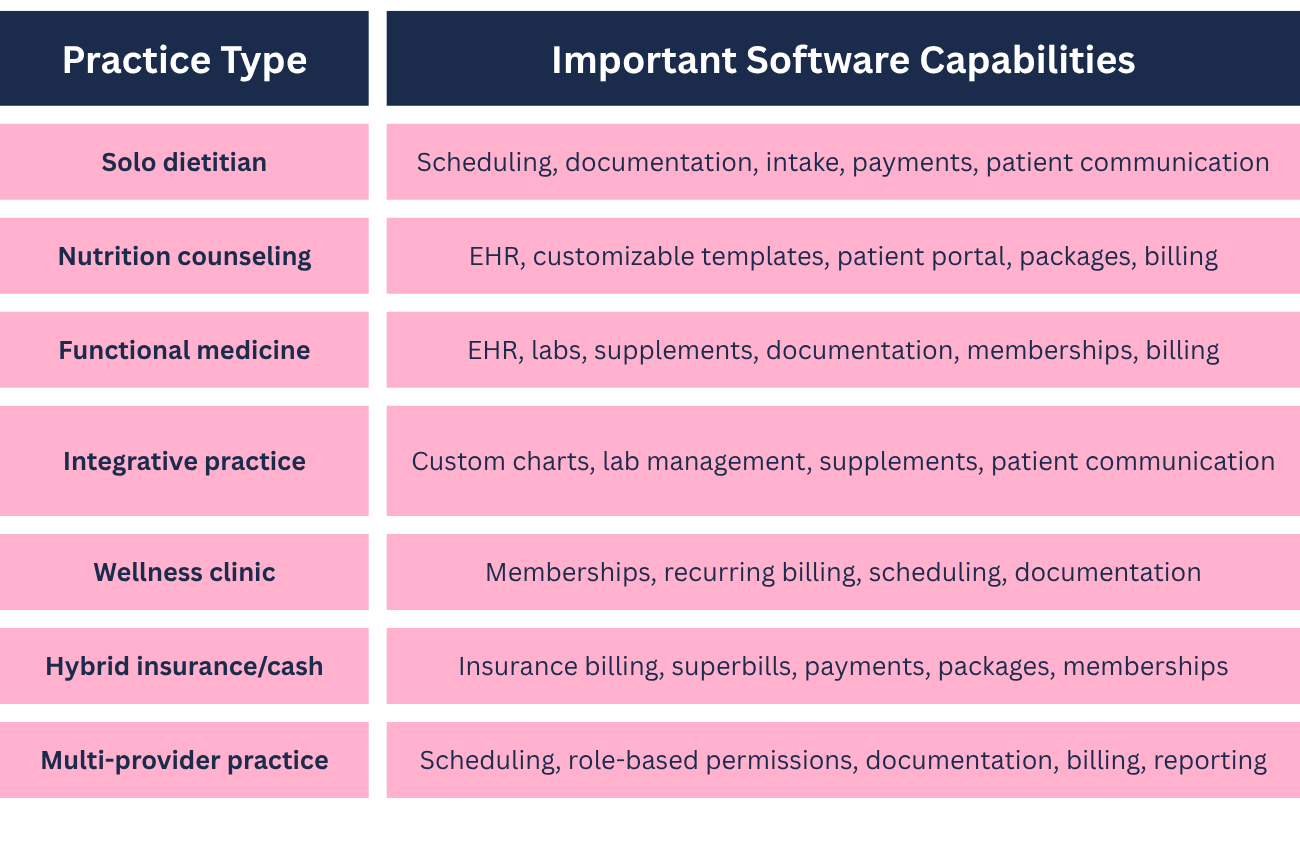
The key is to prioritize the workflows that have the biggest impact on your day-to-day operations.
A practice shouldn't choose software because it has the longest feature list. It should choose software that eliminates the most friction.
Practical Takeaways for Choosing Nutrition Software
Before signing a contract with a nutrition software vendor, take a step back and define what you actually need the system to accomplish.
A few principles can help:
Start with your care model.
A solo dietitian offering one-time consultations has different requirements than a functional medicine practice offering ongoing nutrition programs.
Map the entire patient journey.
Don't evaluate documentation, scheduling, billing, and communication as separate features. Look at how they work together.
Separate must-have features from nice-to-haves.
Meal planning may be essential for one practice and irrelevant to another. Recurring billing may be critical for a membership practice but unnecessary for a provider who bills per appointment.
Look for customization.
Nutrition practices often develop their own assessments, programs, and workflows. Rigid software can create more work instead of reducing it.
Evaluate the financial side.
Make sure the platform supports how you actually charge patients, whether that's fee-for-service, packages, memberships, insurance, or a combination.
Think about growth.
The system that works for one provider may not work once you add practitioners, locations, services, or new revenue streams.
Most importantly, don't evaluate software from a feature checklist alone. Evaluate it by asking how many steps your staff and providers have to complete to get through a normal day.
How OptiMantra Supports Nutrition-Focused Practices
OptiMantra gives nutrition-focused practices a centralized EHR and practice management system to support nutrition counseling alongside broader clinical and business workflows.
- Customize nutrition documentation with flexible chart templates that can be adapted to your practice's assessments, care plans, and clinical workflows
- Keep nutrition-related information in the patient chart alongside diagnoses, medications, lab results, and other clinical information
- Connect laboratory results to patient care with integrations including Labcorp, Quest, Access Medical Labs, and specialty laboratories
- Manage supplements and inventory with tools that support product management, including lot and device serial tracking
- Create memberships and packages for ongoing nutrition programs, wellness services, and prepaid care models
- Support cash-pay and insurance billing with workflows for payments, superbills, CMS-1500 claims, clearinghouse submission, eligibility verification, and ERA posting
- Manage scheduling and patient communication within the same broader practice-management environment
- Support different practice models including nutrition-focused, integrative, functional, wellness, and other specialty practices
- Centralize clinical and administrative workflows so practices can manage nutrition services without relying on multiple disconnected systems
For practices that incorporate nutrition tracking into a broader model of care, OptiMantra provides the flexibility to build nutrition workflows around the way the practice operates.
If you're evaluating software for a nutrition-focused practice, explore how OptiMantra fits your workflow with a demo or free trial.

.png)