.png)
Running a direct primary care (DPC) practice is supposed to simplify healthcare, not create new administrative headaches. Yet many clinics find themselves juggling separate systems for charting, membership billing, scheduling, patient messaging, lab orders, and telehealth. Instead of reducing overhead, disconnected software can increase staff workload and create friction for both providers and patients.
Choosing the right Electronic Health Record (EHR) for DPC practices is about more than documenting visits. The best platforms support recurring memberships, streamline patient communication, simplify clinical workflows, and provide the flexibility that independent practices need to grow.
This guide compares six leading EHR platforms for DPC practices in 2026, highlighting their strengths, potential limitations, and the types of practices they serve best.
Why Choosing the Right EHR Matters for DPC Practices
Direct primary care operates differently than traditional fee-for-service medicine.
Most DPC practices rely on recurring membership revenue instead of insurance reimbursement. Patients often expect same-day communication, longer visits, virtual care options, and a more personalized experience.
Because of this, a traditional EHR built around insurance workflows may not fit the operational needs of a DPC clinic.
An ideal EHR for DPC practices should help providers manage both clinical care and practice operations from a single platform.
Key capabilities often include:
- Membership billing
- Online scheduling
- Secure patient messaging
- Digital intake forms
- Telehealth
- ePrescribing
- Laboratory integrations
- Clinical documentation
- Patient portal access
- Reporting and financial visibility
The fewer systems your team has to manage, the smoother daily operations become.
What to Look for in an EHR for DPC Practices
Before comparing vendors, it's helpful to understand which features have the biggest impact on daily workflows.
Membership Billing
Recurring memberships are the foundation of most DPC practices.
Look for software that supports:
- Automated recurring billing
- Multiple membership plans
- Family memberships
- Package management
- Payment processing
Manual billing quickly becomes difficult as patient volume grows.
Flexible Clinical Documentation
Every DPC practice develops its own care model.
Custom chart templates, macros, and specialty-specific documentation tools can significantly reduce charting time.
Integrated Patient Communication
Patients increasingly expect digital communication.
Features such as:
- Secure messaging
- Appointment reminders
- Patient portals
- Online forms
- Telehealth
can reduce phone calls while improving patient satisfaction.
Laboratory and Prescription Workflows
Ordering labs and prescribing medications should happen without switching between multiple systems.
Integration with major laboratories and electronic prescribing platforms creates a more efficient clinical workflow.
Reporting and Business Visibility
Growing practices benefit from dashboards that provide insight into:
- Membership growth
- Revenue trends
- Provider productivity
- Appointment volume
- Patient retention
Operational visibility becomes increasingly valuable as practices scale.
Top 6 EHR Platforms for DPC Practices (2026)
1. OptiMantra
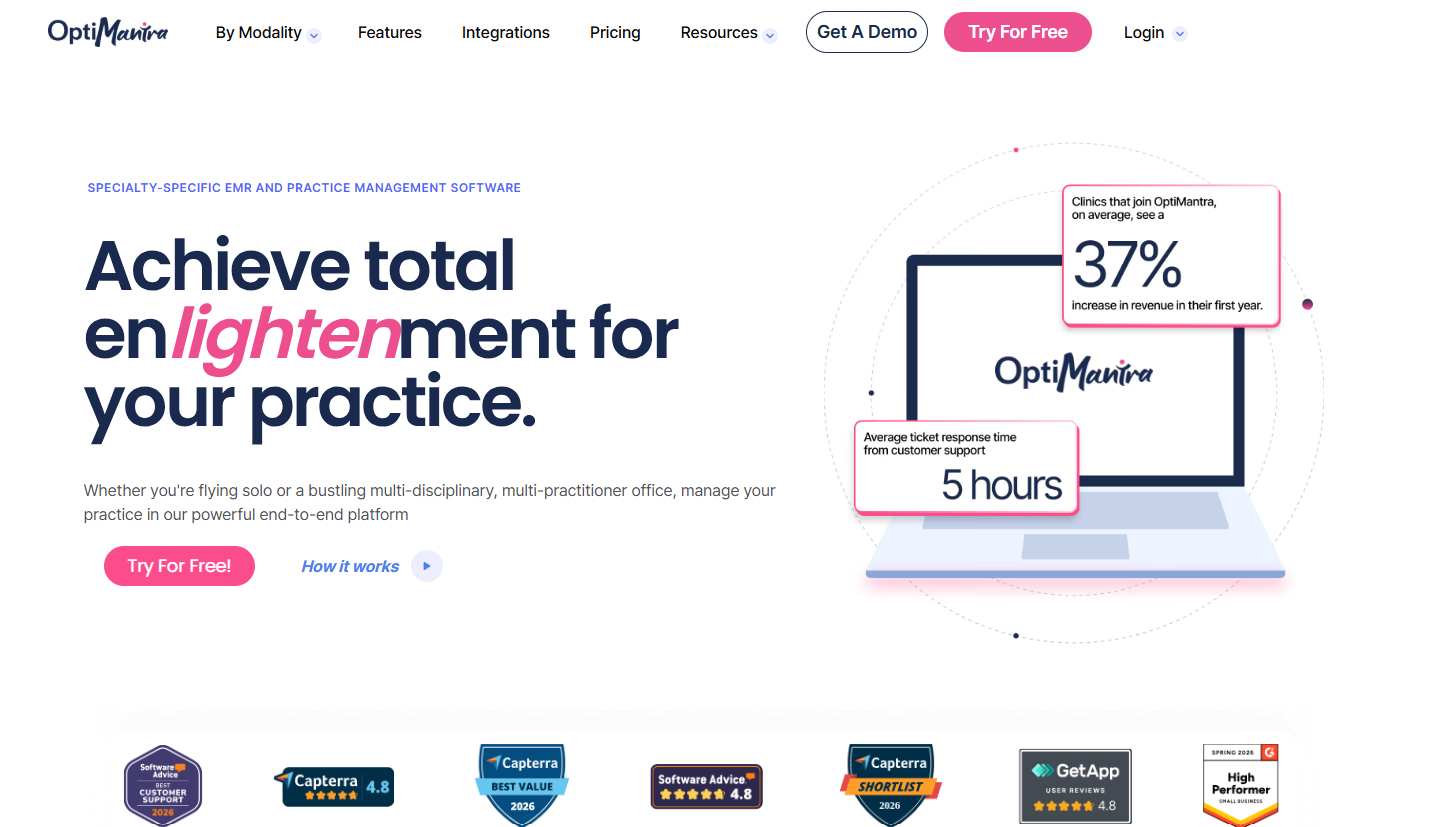
Best for: Growing DPC, functional medicine, integrative medicine, hybrid cash-pay, wellness, and specialty practices.
OptiMantra combines electronic health records, practice management, patient engagement, membership billing, and clinical documentation within a single platform.
Its flexibility makes it particularly appealing for practices that extend beyond traditional primary care by offering wellness services, hormone therapy, nutrition programs, or functional medicine.
Strengths
- Membership billing and recurring payment support
- Customizable chart templates
- HIPAA-compliant patient portal
- Secure messaging
- Integrated telehealth
- ePrescribing (including controlled substances through MDToolbox/Surescripts)
- Lab integrations with Labcorp, Quest, Access Medical Labs, and specialty laboratories
- Digital intake forms and electronic signatures
- Insurance billing support for hybrid practices
- Inventory management for clinics dispensing supplements or products
- AI-powered charting integration through DeepCura
Considerations
Practices seeking an all-in-one platform that supports both DPC memberships and additional specialty services may find OptiMantra especially well suited to their workflow.
User Reviews:
- OptiMantra on Capterra: Rated 4.8/5 Stars
- OptiMantra on G2: Rated 4.8/5 Stars
OptiMantra helps practices streamline day-to-day operations with tools designed to reduce administrative workload and make practice management more efficient.
Don’t just take our word for it. Alena G. states, “My overall experience has been very positive. The platform is intuitive, easy to navigate, and has significantly streamlined many aspects of running my practice. Features such as electronic prescribing, online scheduling, invoicing, and patient management help reduce administrative workload and improve efficiency. The customer support team has been responsive and helpful whenever assistance was needed."
“I LOVE that OptiMantra is always improving their platform and when you have any questions, they are very quick to reply back.” - Krystal H.
Try OptiMantra with a free trial or demo today!
2. Elation Health
Best for: Traditional primary care and independent physician practices.
Elation Health focuses heavily on physician documentation and clinical workflows.
Its interface is designed around primary care visits and longitudinal patient records, making it a popular option among independent physicians.
Strengths
- Strong charting experience
- Integrated patient portal
- ePrescribing
- Population health tools
- Referral management
Considerations
Some DPC practices may require additional solutions for membership management or specialty workflows depending on their operational model.
User Reviews:
- Elation on Capterra: Rated 3.8/5 Stars
- Elation on G2: Rated 4.4/5 Stars
Elation Health is an EHR platform designed to support clinical documentation, patient management, and day-to-day healthcare workflows. However, some users have identified limitations related to customer support, reporting, and scalability.
Ilanit M. wrote, “We decided to discontinue with Elation Health for a variety of reasons: customer support wasn't great, there was no analytics or robust reporting, and it wouldn't have allowed us to scale our business in a way that we envision for our company. It is a good entry-level EHR software but is not robust enough for our needs.”
3. Cerbo
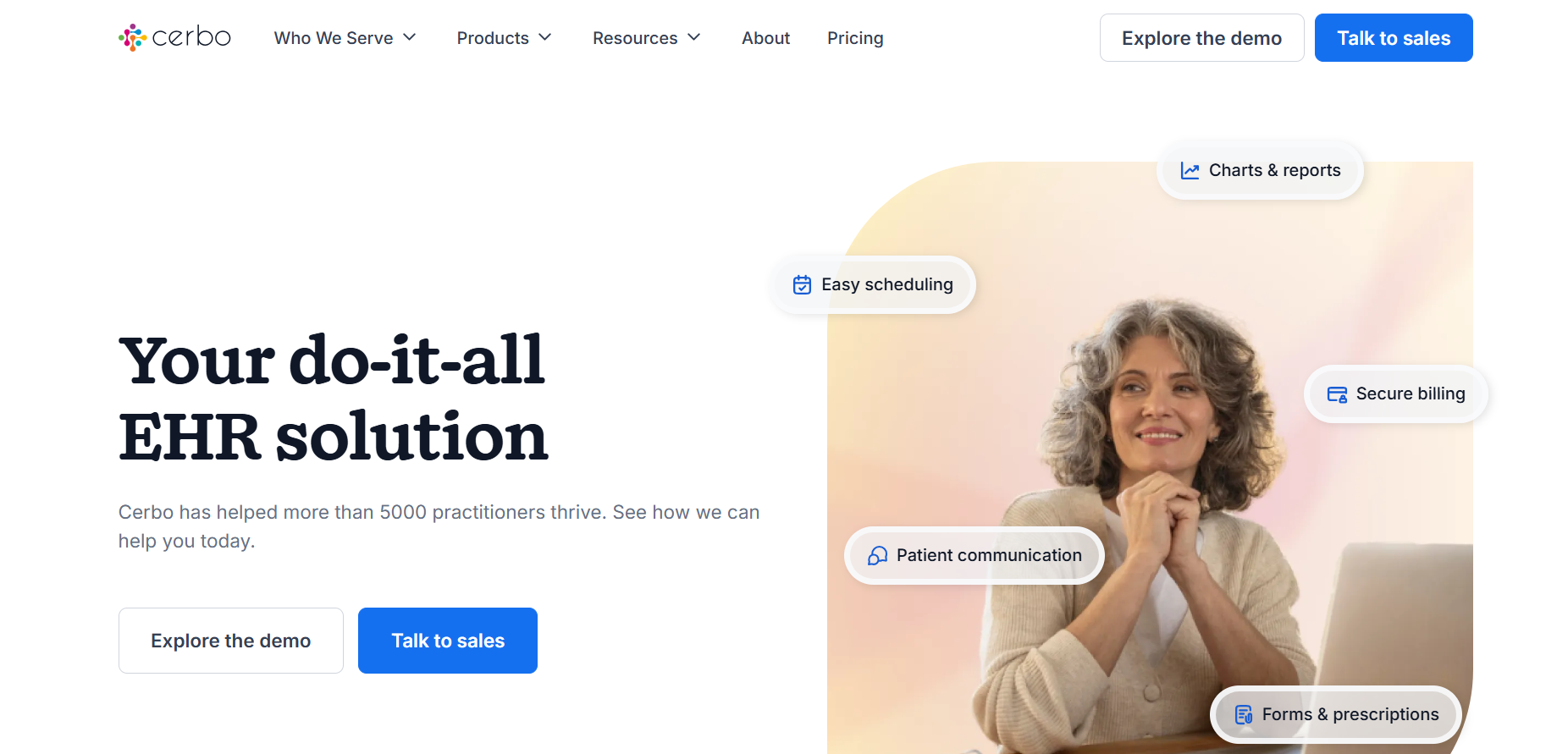
Best for: Functional medicine, concierge medicine, and DPC clinics.
Cerbo has built a strong reputation among cash-pay and functional medicine providers.
Its extensive customization options appeal to clinics offering personalized treatment plans.
Strengths
- Highly customizable templates
- Patient portal
- Secure messaging
- Telemedicine
- Supplement workflow support
- Laboratory integrations
Considerations
The platform's flexibility can require more setup and customization during implementation.
User Reviews:
- Cerbo on Capterra: Rated 4.3/5 Stars
- Cerbo on G2: Rated 4/5 Stars
Cerbo is an EHR and practice management platform designed to support both solo practitioners and growing healthcare teams with a broad range of clinical and administrative tools.
Dr. Traci J. highlights the platform’s flexibility and scalability, stating, “I am a solo practitioner and Cerbo allows me to do all of the things I need to do. It also allows for a team. I love the online scheduler and that I can process payments. It is very robust and there are features I'm not using yet. I like that they are available to me when my practice reaches that level so I won't have to change EMR's again. Customer support is excellent.”
4. Healthie
Best for: Nutrition practices, health coaching, wellness clinics, and virtual care.
Healthie emphasizes patient engagement and collaborative care.
Many practices offering lifestyle medicine, nutrition counseling, or coaching appreciate its communication features.
Strengths
- Telehealth
- Messaging
- Scheduling
- Patient portal
- Nutrition tracking
- Online programs
Considerations
Practices with more complex medical documentation or advanced primary care workflows may evaluate whether its clinical functionality aligns with their needs.
User Reviews:
- Healthie on Capterra: Rated 4.4/5 Stars
- Healthie on G2: Rated 4/5 Stars
Healthie is a practice management platform that offers tools for client management, scheduling, communication, and other day-to-day workflows.
Alexa S. described the platform as a “solid all-in-one solution,” while also noting areas where the user experience could be improved: “My overall experience with Healthie has been decent—it’s not bad, but it’s not the best either. The platform offers a wide range of features that are helpful for managing clients, scheduling, and communication, which makes it a solid all-in-one solution. However, it can feel a bit unintuitive at times, and certain tasks take more steps than expected. There’s also a noticeable learning curve when getting started.”
5. DrChrono
Best for: Small medical practices seeking broad specialty support.
DrChrono offers an extensive feature set covering scheduling, charting, billing, and mobile documentation.
Its mobile capabilities remain one of its notable strengths.
Strengths
- Mobile EHR
- Scheduling
- Medical billing
- ePrescribing
- Patient portal
Considerations
Feature availability varies across subscription tiers, so practices should compare plans carefully.
User Reviews:
- DrChrono on Capterra: Rated 3.9/5 Stars
- DrChrono on G2: Rated 3.4/5 Stars
DrChrono is an EHR and practice management platform designed to support clinical, scheduling, patient management, and billing workflows. However, some users have reported concerns related to usability, reliability, and customer service.
Edward described his experience as “Unintuitive, clunky, unreliable,” while also noting that the platform has potential but that “poor customer service, bugs, and very poor user experience” affected his experience.
6. CharmHealth
Best for: Independent practices looking for a cloud-based EHR.
CharmHealth supports a variety of practice types and includes both clinical and administrative tools.
Its cloud-based approach allows providers to access records from virtually anywhere with an internet connection.
Strengths
- Cloud-based access
- Patient portal
- Scheduling
- Telehealth
- ePrescribing
- Billing capabilities
Considerations
Practices with highly specialized DPC workflows may want to evaluate customization options during the selection process.
User Reviews:
- CharmHealth on Capterra: Rated 4.2/5 Stars
CharmHealth is an EHR and practice management platform that combines clinical workflows with scheduling, payments, telemedicine, and other practice management tools. Some users have highlighted both the convenience of having these functions in one platform and concerns related to technical issues, customer support, and payment processing.
Dr. Aaron B. stated, “Liked the idea of a fully integrated EHR and scheduling and payment system. But the tech issues and lack of support recently and overpriced payment processing platform is adding up to more hassle than value at this time.”
Side-by-Side Comparison
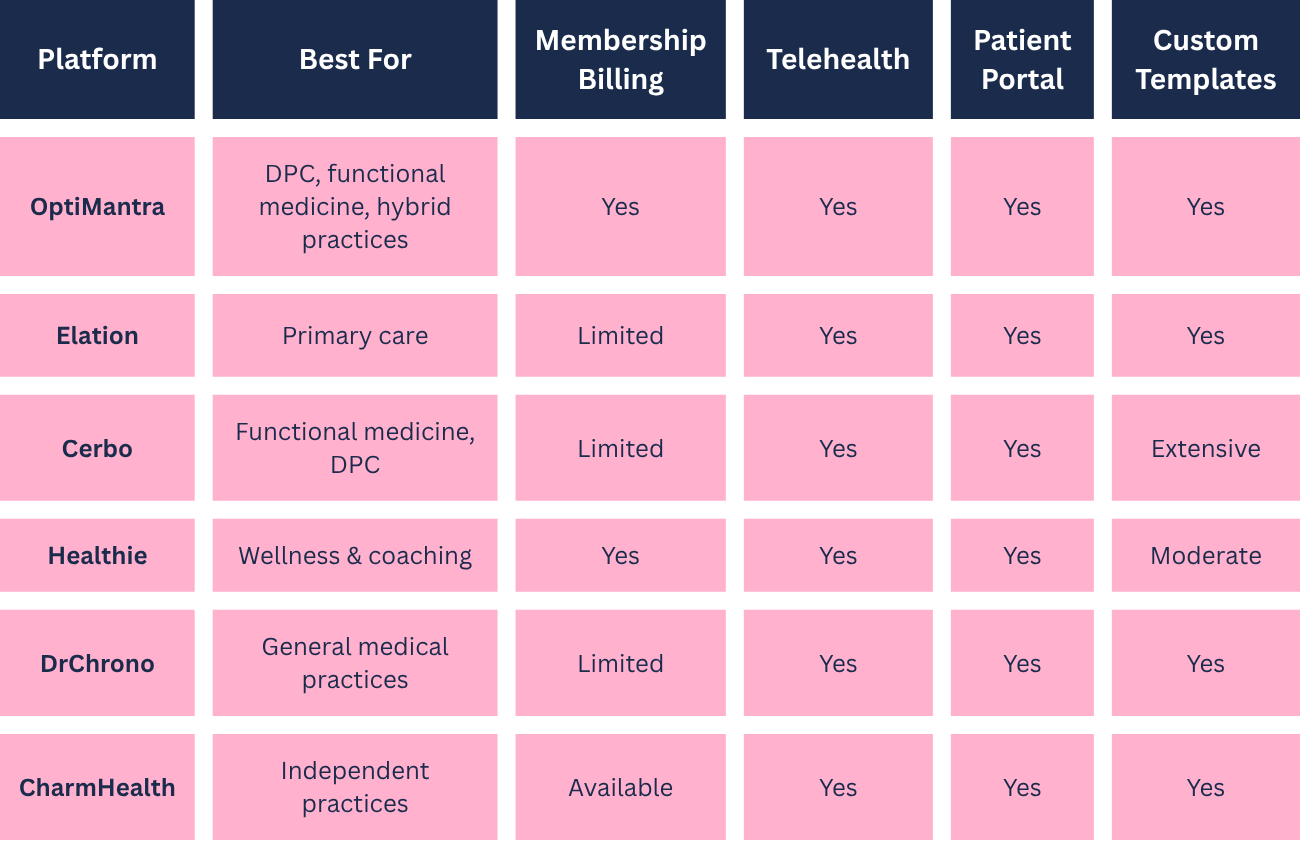
Features and prices may change over time. Verify current capabilities and pricing directly with each vendor.
How to Choose the Right EHR for Your DPC Practice
Every clinic has different priorities.
When evaluating vendors, consider questions such as:
- Does the software support recurring membership billing?
- Can it grow with your practice?
- How customizable are clinical templates?
- Does it integrate with your preferred laboratories?
- Is telehealth included?
- How easy is patient communication?
- Can patients complete forms electronically?
- What reporting tools are available?
- How responsive is customer support?
- What is the implementation process?
It's also worth involving both providers and administrative staff in the evaluation. Front-desk teams, nurses, and clinicians often identify workflow challenges that aren't obvious during a software demonstration.
Choosing an EHR That Fits Your Practice
For direct primary care clinics, efficiency often depends on having one platform that connects clinical care with everyday business operations. OptiMantra is designed to support that goal by bringing together electronic health records, practice management, and patient engagement tools.
Features that are especially relevant for DPC practices include:
- Membership billing with recurring payment support
- Customizable chart templates for personalized documentation
- Digital intake forms and electronic signatures through the patient portal
- Secure patient messaging
- HIPAA-compliant telehealth integration
- ePrescribing, including controlled substances through MDToolbox and Surescripts
- Integrated lab ordering and results from Labcorp, Quest, Access Medical Labs, and specialty laboratories
- Scheduling and appointment management
- Insurance billing tools for hybrid practices that offer both membership and insurance-based services
- Practice reporting and financial visibility to help monitor operational performance
By consolidating these functions into one system, clinics can reduce duplicate work, improve documentation consistency, and spend more time focused on patient care.
If you're exploring an EHR built for DPC, functional medicine, wellness, and hybrid practices, consider requesting an OptiMantra demo or free trial to see how an integrated platform can simplify practice management while supporting exceptional patient care.
Frequently Asked Questions About EHRs for DPC Practices
What should a DPC practice look for in an EHR?
A DPC practice should look for an EHR that supports both patient care and the operational side of a membership-based practice. Important features can include recurring membership billing, customizable chart templates, online scheduling, secure patient messaging, patient portals, digital intake forms, telehealth, ePrescribing, laboratory integrations, and reporting tools.
Do DPC practices need membership billing software?
Membership billing software can help DPC practices manage recurring payments and multiple membership plans more efficiently. Useful capabilities may include automated recurring billing, family memberships, package management, and integrated payment processing.
Is OptiMantra an EHR for DPC practices?
OptiMantra is a cloud-based EMR and practice management platform that supports DPC, functional medicine, integrative medicine, wellness, hybrid cash-pay, and specialty practices. Its DPC-related capabilities include membership billing, customizable chart templates, patient messaging, digital intake forms, telehealth, ePrescribing, laboratory integrations, scheduling, and insurance billing support for hybrid practices.
Does OptiMantra support recurring membership billing?
Yes. OptiMantra supports membership billing and recurring payments, making it applicable to DPC practices that use recurring membership revenue as part of their business model.
What features are important in DPC practice management software?
Important DPC practice management features can include membership and payment management, scheduling, patient communication, digital intake, clinical documentation, laboratory workflows, ePrescribing, patient portals, telehealth, and reporting. Combining these functions can reduce the need to manage multiple disconnected systems.
How do I choose an EHR for my DPC practice?
Start by identifying the workflows that matter most to your practice. Consider whether the platform supports recurring membership billing, customizable documentation, laboratory integrations, telehealth, electronic forms, patient communication, reporting, customer support, and future practice growth. It can also be useful to involve both clinical and administrative staff when evaluating software.