A longevity clinic signs up for an Electronic Medical Record (EMR) trial, spends a week clicking through dashboards, testing generic templates, and scheduling a few mock appointments.
Everything looks polished. The interface is clean. The sales demo was impressive. The feature list checks all the expected boxes.
Then the clinic launches.
Within a month, staff are manually recreating intake forms. Providers are documenting outside the system because charting feels clunky. Lab review workflows require too many steps. Membership billing doesn’t fit the clinic’s care model. Patient communication ends up split across email, text, and portal messages.
It’s a familiar story.
The problem usually isn’t that the software lacked functionality. It’s that the clinic tested the wrong things during the evaluation process.
For longevity clinics, choosing an EMR is not the same as choosing software for a conventional primary care office. These practices often operate with highly personalized care models, recurring biomarker tracking, longitudinal patient relationships, advanced diagnostics, memberships, and multi-touch communication.
That complexity makes the EMR trial phase especially important.
A thoughtful evaluation helps reveal whether a platform can support the way your clinic actually delivers care, not just whether it looks good in a product demo.
Why an EMR Trial Matters More for Longevity Clinics
Longevity medicine has evolved quickly.
What was once considered niche preventive care has expanded into a sophisticated model that blends:
- Functional medicine
- Precision diagnostics
- Hormone optimization
- Metabolic health monitoring
- Lifestyle intervention programs
- Performance optimization
- Recurring biomarker analysis
- Membership-based care structures
This creates workflow demands that standard EMRs often struggle to support.
A longevity clinic might need to manage:
- Extensive intake assessments
- Long-form consultations
- Customized treatment protocols
- Longitudinal lab trend tracking
- Recurring follow-up schedules
- Continuous patient messaging
- Membership billing
- Data-heavy care plans
A generic evaluation process won’t uncover whether an EMR can handle this complexity. That’s why an EMR trial should focus on real-world operational testing. The goal is simple: stress-test the system against your actual workflows.
Start by Testing Your Full Patient Journey
One of the most common mistakes clinics make during an EMR trial is evaluating features in isolation.
A platform may have strong scheduling. It may offer customizable charting. It may include patient messaging. That doesn’t necessarily mean those workflows connect smoothly.
Longevity clinics should simulate the complete patient experience from first contact through long-term follow-up.
Test the full sequence:
Inquiry → Scheduling → Intake → Initial consultation → Lab ordering → Results review → Treatment planning → Recurring follow-ups → Ongoing communication → Billing
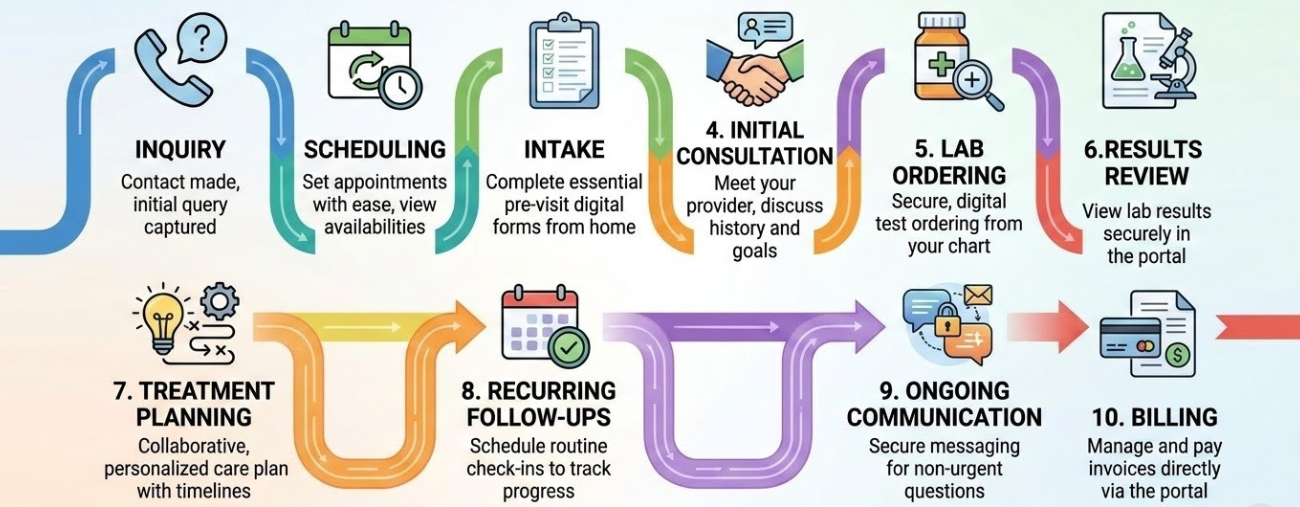
This reveals friction points that surface only when workflows interact.
Ask practical questions:
- Does intake data flow directly into the chart?
- Can providers easily access historical notes during follow-ups?
- Are labs connected to treatment documentation?
- Can recurring visits be scheduled efficiently?
- Is financial information visible alongside clinical workflows?
If the system feels fragmented during simulation, those inefficiencies will become larger problems after implementation.
Evaluate Documentation Workflows Carefully
Documentation is where many longevity clinics encounter hidden operational strain. A polished interface can mask inefficient charting workflows.
During your EMR trial, test documentation under realistic conditions. Not just a simple SOAP note. Build and complete notes that reflect actual longevity care.
Test Initial Consultation Documentation
Initial visits in longevity medicine are often detailed and data-rich.
Providers may document:
- Comprehensive health history
- Lifestyle patterns
- Nutrition habits
- Sleep quality
- Exercise metrics
- Stress patterns
- Supplement use
- Family history
- Biomarker interpretation
- Long-term health goals
Your EMR should support this depth without forcing excessive clicks or fragmented templates.
Test whether providers can document efficiently while maintaining clinical nuance.
Assess Follow-Up Workflow Efficiency
Longitudinal care depends on repeat visits. Your system should make follow-up documentation faster, not repetitive.
Test whether templates allow efficient updates for:
- Biomarker changes
- Protocol adjustments
- Medication titration
- Lifestyle adherence
- Symptom progression
- Next-step planning
If providers are rewriting large portions of the note each visit, charting fatigue will build quickly.
Test Lab Ordering and Biomarker Tracking
For many longevity clinics, lab interpretation is central to care delivery. This is not a minor workflow. It’s often the clinical foundation of treatment planning.
When trialing an EMR you should include testing how the system handles:
- Lab ordering workflows
- Result integration
- Historical trend visibility
- Biomarker comparison over time
- Clinical interpretation documentation
Providers should be able to quickly connect data points to treatment decisions. If reviewing trends requires excessive navigation, clinical efficiency suffers.
Evaluate Scheduling for Recurring Care Models
Longevity care is inherently longitudinal. Patients often follow structured care plans involving recurring touchpoints over months or years. That makes scheduling flexibility essential.
During your EMR trial, test whether the platform supports:
Recurring appointment workflows
Can staff quickly schedule a six-month care pathway?
Or does each visit require manual setup?
Variable appointment lengths
Longevity clinics often use different time blocks for:
- Discovery calls
- Initial evaluations
- Lab reviews
- Follow-up optimization visits
- Coaching sessions
Scheduling should adapt to your care model.
Automated reminders and confirmations
Retention depends partly on keeping patients engaged and on schedule.
Manual reminder processes create unnecessary administrative burden.
Test Membership and Billing Workflows
Many longevity clinics operate on recurring membership models. This is where traditional medical software often falls short.
An EMR may support basic payment processing but struggle with recurring care structures.
During your trial, test:
- Membership billing setup
- Recurring payment workflows
- Package-based service tracking
- Financial reporting visibility
- Payment collection workflows
You should be able to answer practical business questions easily.
For example:
- Which memberships generate the most revenue?
- Which patients are overdue for payment?
- How does retention affect recurring revenue?
Operational clarity matters as much as clinical usability.
Review Patient Communication Tools
Longevity medicine typically involves more between-visit communication than episodic care models.
Patients may need support for:
- Lab clarification
- Protocol adjustments
- Supplement questions
- Symptom updates
- Progress check-ins
During your EMR trial, test how communication actually works. Don’t just verify that messaging exists. Assess whether it is practical.
Key questions:
- Are messages securely linked to the patient record?
- Can providers respond efficiently?
- Can staff triage administrative questions?
- Is communication centralized?
Scattered communication creates both inefficiency and documentation risk.
Test Reporting and Clinical Visibility
Longevity clinics often rely on outcomes-driven care. That requires visibility. A strong EMR trial should include testing reporting functionality.
Can the system surface useful clinical and operational insights?
Look for reporting capabilities related to:
- Clinical progress: Track treatment effectiveness over time.
- Patient retention: Long-term engagement is often a core success metric.
- Revenue performance: Membership and program financial visibility should be accessible.
- Provider workload: Operational efficiency depends on understanding scheduling and utilization trends.
Good reporting supports better decision-making. Weak reporting forces manual analysis.
Evaluate Customization Without Complexity
Customization matters for specialized practices, but there’s a balance. Too little flexibility creates rigid workflows while too much complexity makes implementation overwhelming.
During your EMR trial, assess whether your team can realistically configure:
- Documentation templates
- Intake forms
- Scheduling workflows
- Patient communications
- Care pathways
The ideal system supports personalization without requiring constant technical workarounds.
Practical Questions to Ask During an EMR Trial
A productive EMR trial should leave you with operational clarity.
Ask your team:
- Does this match how we deliver care? Not just how generic clinics operate, but your clinic.
- Where did workflow friction appear? Small frustrations during testing often become major inefficiencies at scale.
- Could providers complete documentation efficiently? Time spent charting directly affects provider sustainability.
- Would this simplify staff coordination? Front-desk efficiency has a major downstream effect on patient experience.
- Can this support growth? The system should scale with increasing patient volume and evolving care models.
An EMR Built Around the Realities of Longevity Care
For longevity clinics evaluating platforms, workflow alignment is critical.
OptiMantra supports specialized care models by connecting clinical and operational workflows within one integrated platform.
Capabilities particularly relevant when looking for an EMR include:
- Customizable charting and documentation: Build templates for detailed initial assessments, biomarker reviews, and longitudinal follow-up workflows.
- Integrated scheduling: Support recurring appointments, variable visit structures, and automated patient reminders.
- Patient communication tools: Centralize secure messaging within the patient record for more organized follow-up communication.
- Financial visibility: Track memberships, payments, and practice performance within connected reporting workflows.
- Lab workflow support: Integrate lab ordering and result review into longitudinal clinical documentation.
For longevity clinics, testing these workflows in realistic scenarios helps clarify whether the system supports both current operations and future growth.
If your practice is exploring EMR options, reviewing a live OptiMantra demo or starting a free trial can help you evaluate how well its workflows align with longevity-focused care delivery.