A practice can build a successful peptide therapy program and still discover that its payment processor has a problem with part of the business.
The surprise often comes when a clinic combines conventional medical services or FDA-approved therapies with products marketed as "research peptides," "wellness peptides," or experimental compounds. From the practice's perspective, they may all belong to the same treatment model. From a payment processor's perspective, they can represent very different levels of risk.
That distinction is becoming increasingly important for practices offering weight management, hormone care, longevity services, integrative medicine, and other specialty programs.
For a clinic offering experimental peptides payment processing can be particularly difficult when the products are not FDA-approved for the intended use, are marketed for human use despite "research use only" language, or create uncertainty about who is actually supplying and dispensing the product.
The central issue is not simply whether a peptide is popular. It is whether the payment processor can clearly understand what the merchant is selling, who is providing it, how it is fulfilled, and whether the underlying transaction fits within the processor's risk and compliance requirements.
Why Peptide Therapy Creates a Payment-Processing Problem
A specialty practice may offer several services under one roof:
- Medical consultations
- Weight-management programs
- Hormone therapy
- FDA-approved medications
- Compounded medications
- Nutritional counseling
- Wellness memberships
- Peptide-related services
The clinical team may see these as different tools within a broader patient-care strategy. A payment processor sees a merchant account with transactions flowing through it.
That means the processor has to evaluate the business at the transaction level.
- What is the patient paying for?
- Who supplies the product?
- Is the product FDA-approved for the intended use?
- Is it being dispensed by a licensed pharmacy?
- Is the practice itself selling the product?
- Is the product being shipped directly to the patient?
- Does the practice describe the product as a medication, a wellness product, or a research compound?
These questions become particularly important when a practice combines conventional therapies with products that fall into a less clearly defined regulatory category.
The Key Distinction: Approved Therapies vs. Experimental Peptides
Not every peptide-related service presents the same payment risk. A useful starting point is to separate the market into two broad categories.
The More Workable Tier: FDA-Approved Therapies
Some medications used in specialty practices have FDA-approved indications.
Semaglutide is one example. It is an FDA-approved prescription drug, with specific approved products and indications.
Testosterone is another commonly encountered prescription therapy, although it is important to note that testosterone is a hormone rather than a peptide. It is FDA-approved for specific medical uses and is subject to prescription and other applicable requirements.
When a practice is providing an FDA-approved prescription therapy within an appropriate clinical and dispensing framework, a payment processor has a more established regulatory category to evaluate.
That does not guarantee standard processing terms. The practice can still be subject to underwriting based on its transaction volume, business model, recurring billing, fulfillment method, chargeback history, and other factors.
But the underlying product is not inherently an unknown category simply because the practice uses it in a specialty program.
The More Difficult Tier: Experimental or Unapproved Peptides
BPC-157 and Selank illustrate a different situation.
Neither is FDA-approved as a drug for general therapeutic use in humans in the United States. Products marketed as "research use only" are also not automatically transformed into approved human medications simply because a practice or consumer believes they have therapeutic potential.
This distinction matters.
A payment processor may view transactions involving these products very differently from transactions involving established prescription drugs. The issue can become even more complicated when a business markets an experimental peptide directly to consumers while simultaneously describing it as a treatment.
That creates questions about the actual nature of the transaction. Is the customer buying a legitimate medical service, a prescription drug, a research product, or something else?
If the answer is unclear, underwriting becomes harder.
What Are BPC-157 and Selank?
They are also frequently associated with claims involving areas such as recovery, inflammation, cognition, anxiety, or other health outcomes.
But popularity is not the same as FDA approval.
BPC-157
BPC-157 is an experimental peptide that has attracted interest because of preclinical research and online discussion about potential therapeutic applications. It is not FDA-approved as a drug for human therapeutic use in the United States. That distinction is critical for healthcare businesses.
A product's appearance on a supplier website, its availability through a "research" vendor, or the existence of scientific publications does not establish FDA approval for use as a human medication.
Selank
Selank is another experimental peptide that has received attention in research and wellness circles. Like BPC-157, it is not an FDA-approved drug for general human therapeutic use in the United States.
A practice considering any use of an unapproved compound needs to evaluate the applicable federal and state requirements with qualified legal, regulatory, pharmacy, and clinical professionals. Payment processing should not be used as a substitute for that analysis.
Why "Research Use Only" Can Be a Major Warning Sign
"Research use only" language is particularly important for payment processors.
A product labeled for research use is not automatically an acceptable product for human consumption or treatment.
That creates a potential mismatch if a merchant's website says one thing while its transactions appear to involve something else.
For example, imagine a business purchases a peptide labeled "research use only" and then markets it to patients as part of a treatment protocol.
A processor may ask:
- What exactly is being sold?
- Who is the manufacturer?
- Who is supplying the product?
- Is it intended for human use?
- Is it FDA-approved?
- Is the merchant authorized to sell or dispense it?
- Why does the product carry research-use language?
- What claims are being made about it?
- Is a prescription involved?
- Who is responsible for fulfillment?
The more difficult these questions are to answer, the more difficult the merchant can be to underwrite.
Why Processors May Treat Experimental Peptides Differently
Payment processors are exposed to financial risk when transactions result in disputes, refunds, regulatory problems, or other losses.
An experimental peptide transaction can potentially introduce several layers of uncertainty at once.
Regulatory uncertainty
The processor may have difficulty determining whether the product or transaction falls within an acceptable category.
Product uncertainty
An experimental compound may not have the same established regulatory status as an FDA-approved medication.
Marketing uncertainty
Claims made about experimental products can create additional concerns if they imply treatment of medical conditions without appropriate support or authorization.
Fulfillment uncertainty
The processor may need to understand who actually supplies and ships the product.
Chargeback risk
Patients may dispute transactions if products are delayed, unavailable, different from what they expected, or not delivered.
Business-model uncertainty
A merchant selling medical consultations alongside experimental products may be harder to classify than a practice offering a straightforward clinical service.
None of these factors means that every peptide-focused practice will be treated the same way. It means the merchant account can become more difficult to underwrite.
The Problem With Mixing Approved and Experimental Products
This is where Bart Phelps' warning becomes especially relevant:
"Mix both on one account and you risk losing processing for everything."
The statement captures an important payment-processing concept, but it should not be interpreted as a universal rule that every processor will automatically terminate a mixed account.
The underlying concern is concentration of risk.
Suppose a practice has a relatively conventional business model built around:
- Office visits
- FDA-approved prescription therapies
- Hormone management
- Laboratory testing
- Medical weight management
Then the practice adds BPC-157, Selank, or other products marketed as experimental peptides. The practice may think it has simply added another revenue stream.
The processor may see a merchant whose overall activity has changed. If the processor determines that one part of the business falls outside its acceptable risk parameters, the consequences may extend beyond that individual transaction type. Depending on the processor's agreement and underwriting rules, the merchant could face additional review, restrictions, reserves, or termination.
That is why practices should not assume that keeping experimental products on the same merchant account as established medical services is harmless.
One Website Does Not Necessarily Mean One Risk Profile
The same issue applies to marketing.
A practice might have a website that lists:
- Semaglutide
- Testosterone
- BPC-157
- Selank
- Peptide therapy
- IV therapy
- Longevity programs
From a marketing perspective, this can look like one comprehensive service menu. From a processor's perspective, the service menu contains multiple risk categories. The practice should be prepared to explain each one separately.
A processor may want to know which services generate revenue, how much revenue each category represents, and how each transaction is fulfilled.
FDA-Approved vs. Experimental Peptides: Why the Difference Matters
The phrase "peptide therapy" can make very different products sound like members of the same category.
They are not necessarily equivalent.
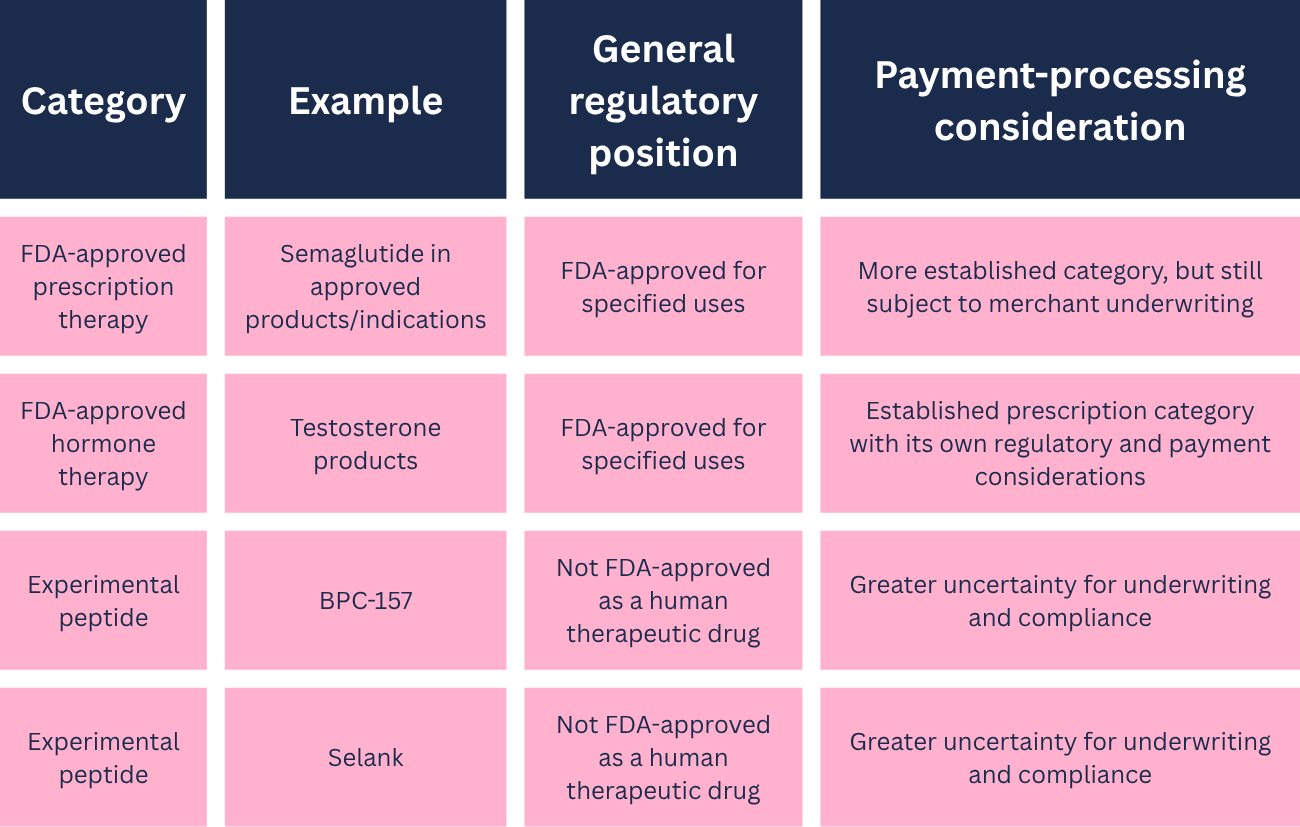

The table is a general framework, not a prediction of how any individual processor will classify a merchant.
It also does not determine whether a particular practice's use of a product is lawful. That requires analysis of the actual product, source, prescribing and dispensing arrangement, intended use, and applicable federal and state law.
Why a Research Peptides Merchant Account Can Be Difficult to Obtain
A practice searching for a research peptides merchant account risk assessment may find that payment providers ask considerably more questions than they would for a conventional medical practice.
That is because "research peptide" can describe a business model with significant ambiguity.
A provider may say:
"We don't sell the peptide. We provide a consultation."
But if the patient pays the practice and receives the peptide as part of the program, the processor may still want to understand the entire transaction.
Likewise, a practice may say:
"The product is research use only."
That does not necessarily resolve the issue.
It may create another question:
Why is a product labeled for research being included in a transaction with a human patient?
The payment processor is not making a clinical determination. It is assessing the merchant relationship and the potential exposure associated with the transactions.
Compounding Pharmacy Risk Is a Separate Question
Practices should also distinguish experimental peptides from compounded medications.
Compounded drugs are not inherently the same thing as experimental research products. A compounded medication can be prepared by a pharmacy under applicable federal and state requirements, including different requirements that can apply to 503A pharmacies and 503B outsourcing facilities.
That does not mean every compounded medication is FDA-approved. Compounded drugs generally are not FDA-approved, and the FDA does not verify their safety, effectiveness, or quality in the same manner as approved drugs.
At the same time, compounding is a regulated part of the healthcare system when performed under applicable requirements.
This is an important distinction for practices because the payment-processing risk of a legitimate compounded prescription arrangement should not automatically be equated with the risk of selling a "research use only" peptide directly to consumers. The specific arrangement matters.
Keep the Categories Straight
For payment and compliance discussions, it helps to distinguish:
- FDA-approved medication: An approved drug with specified FDA-approved indications, labeling, and requirements.
- Compounded medication: A drug prepared by a compounding pharmacy under applicable requirements; compounded drugs generally do not carry FDA approval in the same way commercially manufactured drugs do.
- Experimental/unapproved peptide: A substance that has not been FDA-approved as a drug for the intended human therapeutic use.
- Research-use-only product: A product marketed for research rather than approved human treatment. The label does not provide a pathway for treating patients with the product.
These categories should not be collapsed into one broad term such as "peptide therapy."
How Chargebacks Can Put an Entire Account at Risk
Payment processors care about patterns. One disputed transaction may be manageable. A growing pattern of disputes can tell a different story.
Experimental peptide businesses can face chargebacks for familiar reasons:
- Product never arrived
- Product arrived late
- Patient expected a different product
- Patient did not understand recurring charges
- Patient canceled but was charged
- Product was unavailable
- Patient claims the transaction was unauthorized
- Marketing claims created different expectations
- Patient expected a medical treatment but received a different service
If several disputes occur within a short period, the processor may look at the merchant more closely. This is especially relevant when a single account contains both conventional medical services and higher-risk products.
The practice could find itself defending not only one disputed peptide transaction but questions about the overall business model.
What Practices Should Do Before Adding Experimental Peptides
The safest approach is to address the classification question before adding a new product to the service menu.
Do not wait until patients are already being charged.
Review the Product
Determine:
- Is it FDA-approved?
- For what indication?
- Is it compounded?
- Who manufactures or compounds it?
- Is it labeled for research use only?
- Who supplies it?
- Who dispenses it?
Review the Business Model
Determine:
- What exactly is the patient purchasing?
- Is the product included in a medical program?
- Is there a separate product charge?
- Does the practice collect the money?
- Does another company collect payment?
- Who ships the product?
- How are refunds handled?
Review the Marketing
Look at the actual language patients see.
Avoid creating a mismatch between:
- Product labeling
- Website claims
- Patient agreements
- Provider documentation
- Payment descriptions
- Merchant-account information
Consistency makes the business easier to understand.
Talk to the Processor Before Launching
If you are adding an experimental peptide service line, ask the processor whether the service is permitted under the existing merchant agreement.
Get the answer before processing transactions.
Adding a service and hoping the processor does not notice is not a sustainable strategy.
Should Approved and Experimental Products Be on the Same Merchant Account?
There is no universal answer because processors have different policies.
But practices should recognize the potential downside.
If a merchant account was originally underwritten based on FDA-approved medical services and the practice later begins processing transactions associated with experimental peptides, the processor may view the business differently.
Before combining service lines, ask:
- Does the existing merchant agreement permit the new service?
- Does the processor require notification of new products?
- Does the processor have restrictions on experimental or research-use products?
- Will the processor re-underwrite the account?
- Could the new service affect reserves or transaction limits?
- Would separate processing arrangements be appropriate?
The answer should come from the payment provider and, where applicable, qualified legal or compliance counsel.
The key is transparency.
A Self-Assessment Checklist for Peptide Practices
Before processing payments for a new peptide-related service, walk through this checklist.
Product
- Is the product FDA-approved?
- If approved, is the intended use consistent with its approved status?
- Is the product compounded?
- Is it supplied by a licensed pharmacy or other appropriate source?
- Is it labeled "research use only"?
- Is the product being marketed for human treatment?
Clinical workflow
- Is a qualified healthcare provider evaluating the patient?
- Is the treatment appropriately documented?
- Is the prescribing process clearly defined?
- Are applicable laboratory and follow-up workflows documented?
Payment workflow
- What exactly does the patient pay for?
- Is billing recurring?
- Is payment collected before fulfillment?
- Who issues refunds?
- Who handles cancellations?
- Who fulfills the product?
Merchant account
- Has the processor approved this specific service line?
- Does the merchant agreement permit it?
- Has the processor been informed about any new products?
- Are the website and merchant application consistent?
- Is the practice prepared for additional underwriting?
If several of these questions are difficult to answer, the practice should resolve the ambiguity before processing transactions.
The Bigger Payment-Processing Lesson
The growth of peptide-focused practices has created a temptation to treat every peptide as another item on the service menu.
From a payment-processing standpoint, that can be a mistake.
Semaglutide, testosterone, BPC-157, Selank, compounded medications, and research-use products do not necessarily occupy the same regulatory or merchant-risk category.
The practice may see a common theme.
The processor sees different products, different regulatory questions, different fulfillment arrangements, and potentially different chargeback exposure.
That difference matters.
Don't Let a New Service Change Your Entire Merchant Profile by Surprise
Before launching an experimental peptide program, ask whether the new service changes the business model that your payment processor originally approved.
If the answer is yes, tell the processor.
A short underwriting conversation before launch can be much easier than trying to resolve an account restriction after transactions have already been processed.
This is especially important for practices that depend heavily on electronic payments for recurring programs, memberships, or high-value treatment plans.
The Goal Is Clarity, Not a Particular Risk Label
A practice does not need to convince a processor that every service is "low risk."
It needs to accurately describe what it does.
That means knowing:
- What products are being used
- What services are being provided
- Who supplies them
- Who dispenses them
- Who bills the patient
- How patients are charged
- How products are fulfilled
- What happens when something goes wrong
Once those pieces are clear, the practice can have a much more productive conversation with its payment provider.
How OptiMantra Supports Peptide-Focused Practice Workflows
Peptide and longevity programs often involve multiple workflows, from patient intake and clinical documentation to prescribing, laboratory monitoring, scheduling, communication, and payments. Having these workflows organized in one system can help practices manage day-to-day operations more efficiently as their programs grow.
OptiMantra supports the clinical and administrative workflows surrounding peptide-focused care, giving practices a centralized platform for managing patient records, appointments, prescriptions, labs, communication, payments, and recurring programs.
For specialty practices managing medication-focused programs, relevant capabilities include:
- Customizable charting: Providers can document patient encounters, assessments, treatment plans, and other clinical information within the patient chart.
- Electronic prescribing: OptiMantra supports e-prescribing through MDToolbox and Surescripts, including EPCS and controlled-substance workflows where applicable.
- Laboratory integrations: Integrated lab workflows can help practices manage laboratory information within the broader patient record.
- Scheduling: Appointments and online booking can be managed as part of the practice's broader workflow.
- Patient portal and messaging: Practices can communicate with patients and manage patient-facing workflows within the platform.
- Integrated payments: Payment activity can be managed within the practice-management environment.
- Memberships and packages: Practices using recurring memberships or prepaid service packages can configure those offerings within OptiMantra.
If your practice is looking for a centralized system to manage the clinical and administrative workflows surrounding specialty care, explore how OptiMantra supports scheduling, documentation, e-prescribing, labs, patient communication, payments, and practice management in one platform with a demo or free trial.
Disclaimer: This article is for informational purposes only and is not legal, medical, or regulatory advice. Practices should verify applicable requirements with qualified professionals before offering peptide-related services.